How Much Time Do You Have Left With Your Parents?
Enter their age and sex, and your age, to see your time together. One parent at a time.
Nobody can know for certain. The figure above is an estimate from the CDC's averages.
See your own estimate
This calculator uses the average for each of you. The free 2-minute assessment estimates your own lifespan from your habits, and the card in your results uses it for your side. Both work for a partner or a friend too.
Start My Assessment →How many more times will you see your parents?
Multiply the years your parent has left on average by how often you visit. The CDC's average for a 70-year-old woman is 16.8 more years. The calculator counts that as 17 whole years, so one visit a month comes to 204 visits.
The table shows the averages at one visit a month. They describe a population, not a person.
| Parent’s age | Mother | Father |
|---|---|---|
| 60 | 25 years 300 visits | 22 years 264 visits |
| 65 | 21 years 252 visits | 18 years 216 visits |
| 70 | 17 years 204 visits | 15 years 180 visits |
| 75 | 13 years 156 visits | 12 years 144 visits |
| 80 | 10 years 120 visits | 9 years 108 visits |
| 85 | 7 years 84 visits | 6 years 72 visits |
| 90 | 5 years 60 visits | 4 years 48 visits |
The table uses the parent's side alone, and the calculator uses both ages.
How the time left with parents calculator works
Their side is the average lifespan for someone of their age and sex from the CDC's life tables, rounded to a whole year. It knows nothing about their habits or their health.
It is the average for people who have already reached that age, so an 80-year-old woman has 9.9 more years on average, far more than subtracting her age from life expectancy at birth would suggest. Why your life expectancy goes up as you get older explains it.
Your side is the same kind of average on this page. On the card after the assessment it is your own estimated lifespan, built on CDC life tables and research covering 40M+ people, adjusted for your habits.
The time together is the number of whole years from this year to the earlier of the two estimates. Multiply the years by how often you meet, and you have the visits. With a parent the earlier estimate is usually theirs, so the answer rests mostly on the average for their age and sex.
With a partner or a friend near your own age, your side counts as much as theirs, and either life could be the shorter one. So for two people close in age the real average is shorter than the figure shown. With a parent the figure usually runs long too, by a smaller amount that shrinks as the age gap grows.
Two details. For anyone under 30, on either side, the page uses the average at birth. On the card, your own estimate also allows for death rates continuing to fall over your lifetime, and the average used for the other person does not.
It is an estimate built on averages, not a prediction about a person. Treat it as a reason to call, not a countdown. The methodology page has the sources behind the estimate and everything it cannot tell you.
Your own estimate, and a card you can share
- Take the 2-minute assessment. 13 quick questions give you your own estimated lifespan. No account needed.
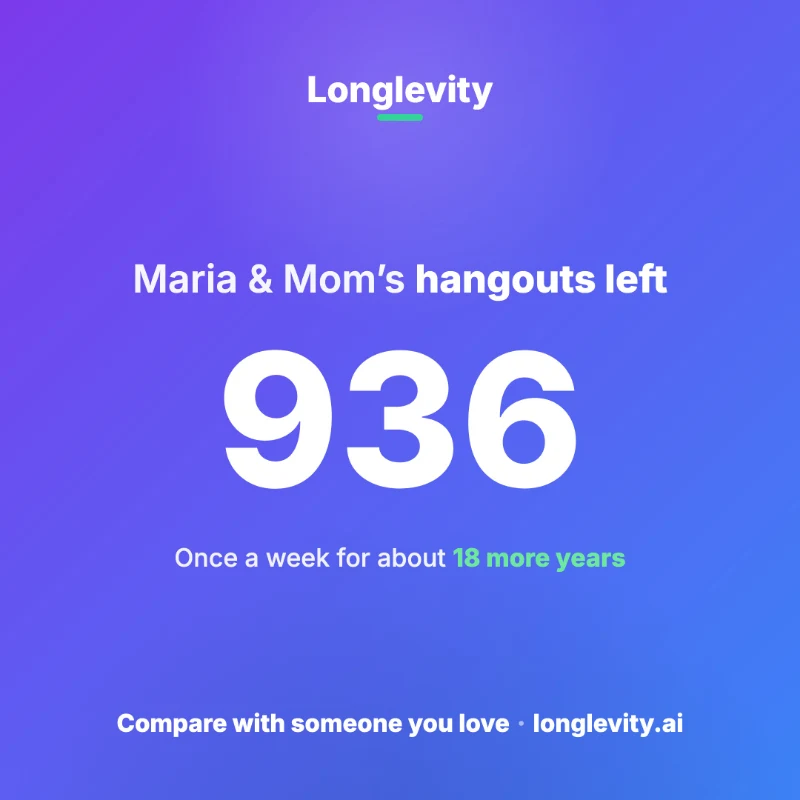
- Tap Hangouts under Share on your results. It is free. Enter their name, their age and their sex.
- Pick how often you see each other, from every day to every few years. The card offers fewer choices than this page, so pick the closest.
- See your time together on one card. The card calls the visits hangouts. It shows years and visits, never a date, and sharing it is up to you.
Doing this kindly
The number is for you first. You don't have to share it. With a parent, the years on the card are usually set by their side of the estimate, so think about how it will land before you send it.
If you do share it, share it as an invitation, with one small thing to do together. This is about supporting each other, never competing. How to compare life expectancy with your partner covers the research on couples and how to have the conversation well.
If they want their own number, they can take the assessment themselves. Then you each have a real estimate to talk about. The card itself still uses the average for their age and sex.
Frequently asked questions
How many more times will I see my parents?
Multiply the years your parent has left on average by how often you visit. The CDC's life tables give a 70-year-old woman 16.8 more years on average, which the calculator counts as 17 whole years. At one visit a month that is 204 visits. At a few visits a year it is 68. The calculator works it out for your own parent and both of your ages.
How much time does my mom or dad have left?
Nobody can know that for one person. On average, the CDC's life tables give 20.7 more years to a woman of 65 and 18.2 to a man of 65. At 80 it is 9.9 for a woman and 8.5 for a man. It is an average, not a prediction about a person, and it knows nothing about their habits or their health.
How does the calculator work out the time we have left?
It takes the average lifespan for each of you, by age and sex, from the CDC's life tables. The time together is the number of whole years from this year to the earlier of the two, and the number of visits is those years multiplied by how often you see each other.
Can I use it for a partner or a friend?
Yes. You need both ages and their sex for the years, and how often you see each other for the visits. For two people near the same age, either life could be the shorter one, so the real average is shorter than the figure shown. You can run it again for someone else.
Whose life expectancy is used for the other person?
The average for someone of their age and sex, from the CDC's life tables. Their habits and their health aren't included. If they take the assessment themselves, they get their own estimate.
Does the calculator work outside the United States?
Yes, with a caveat. The averages come from U.S. CDC data, so in a country whose life expectancy differs from the U.S. the years will be off by roughly that difference, and by less at older ages.
Is anything I enter saved?
The calculator on this page runs in your browser, and nothing you type into it leaves the page. On the card after the assessment, their name, age and sex are used to draw the card on your screen, and the card is shared only if you choose to share it.
Is it morbid to count the visits I have left with my parents?
It can feel that way, and you don't have to look. It is easy to let months slide by without calling the people who matter most, not because we don't care, but because none of it feels urgent. An estimate in visits makes the time concrete. It is built on averages, it is not a prediction about a person, and it never shows a date.
Is the time left with parents calculator free?
Yes. The calculator on this page, the assessment, your numbers, sharing and comparing are free, with no card and no account needed.