Biological Age Calculator
Your calendar age counts birthdays. Your biological age asks a different question. How old do your habits make you?
Longlevity's free biological age calculator answers it in 13 quick questions and about 2 minutes. No blood test and no account. It is an estimate, not a lab test.
Calculate your biological age
The first question is your age. You finish with your biological age and estimated lifespan, side by side. Free.
Start My Assessment →What the calculator shows you
You answer 13 quick questions. They cover your age and sex, your height and weight, nine habits (sleep, exercise, alcohol, diet, stress, relationships, smoking, purpose and health checks) and your family history. When you finish you see three things.
- Your biological age, with how many years younger or older that is than your calendar age.
- Your estimated lifespan beside it, and how many years your habits put you above or below average.
- Your potential, the lifespan within reach with every habit and your weight at the best still open to you, on one timeline with today and your estimate.
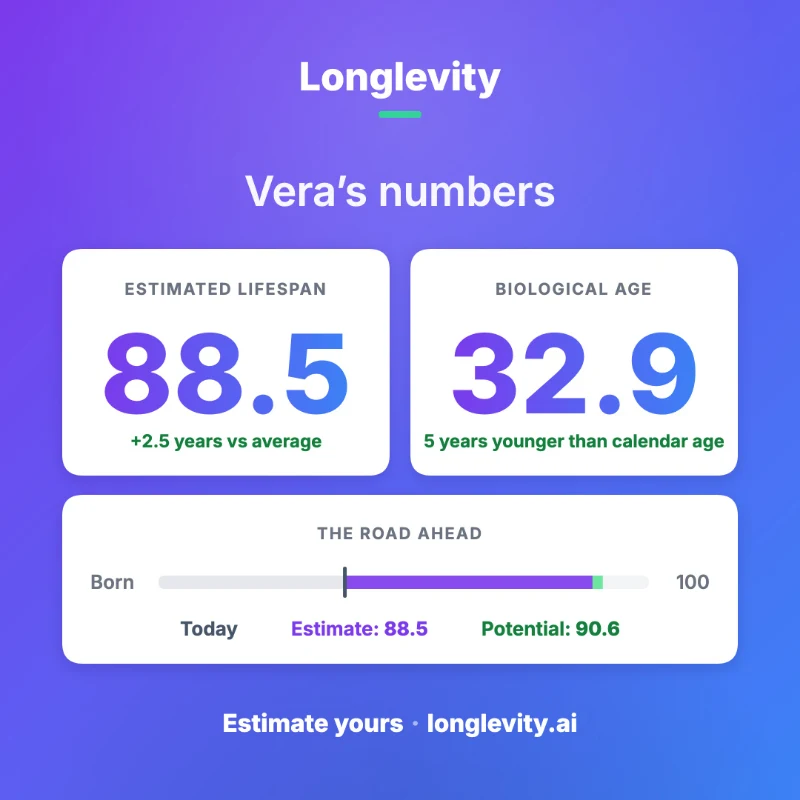
All three are free, with no card and no trial. The full analysis, with every habit ranked by the years it is worth to you and a 90-day plan, is an optional one-time $9 report.
How Longlevity calculates your biological age
If you are 45 and your habits give you the remaining years of an average 41-year-old, your biological age reads about 41.
Your biological age is the age at which an average person of your sex has the same remaining life expectancy that you do, given your habits.
It is built in three steps.
- The baseline. The CDC's United States Life Tables give the average remaining years for someone of your age and sex.
- Your habits. Each answer moves that figure up or down by an adjustment calibrated to the published research and measured against the average person. Good habits overlap in what they do, so their combined gain is discounted and no benefit is counted twice. The studies and the size of each adjustment are on the methodology page.
- The age that matches. We find the age at which the average person has that many years left. That age is your biological age.
If your habits come out close to average, your biological age reads at your calendar age.
It comes from the same engine as the lifespan estimate, and every change to the model is dated in the model changelog. For the three main ways biological age is measured, see biological age vs chronological age.
A habit-based estimate, not a blood test
We don't measure telomeres, epigenetic clocks, or any biomarker, and tests that do are more precise about the body itself.
What a habit-based estimate gives you is the part you can change. A lab test reads where your body is today. This reads the habits behind it, and it is free to repeat whenever they change.
Two limits worth knowing. The estimate is only as good as what you tell it. And if your biological age would read far above your calendar age, we cap the figure we show, so read a very high number as at least that. The methodology page explains the cap and everything else an estimate cannot tell you.
Can you lower your biological age?
The pace at which you age is not fixed, and a small number of ordinary habits reliably slow it. How to lower your biological age covers what the evidence supports and what is oversold.
Re-measuring is always free, so once a new habit has changed your answers you can see how far the number moved.
Frequently asked questions
How do I calculate my biological age?
There are three main ways it is measured. Epigenetic clocks read chemical tags on your DNA. Blood panels read biomarkers. Questionnaires estimate it from your habits, which is what this calculator does. We take the average remaining life expectancy for your age and sex from the CDC's United States Life Tables, move it up or down by adjustments calibrated to the published research on your habits, and find the age at which an average person has that many years left. The full method is on the methodology page.
How accurate is this biological age test?
Less precise than a lab test, and it measures something different. It is an estimate from your habits. We don't measure telomeres, epigenetic clocks, or any biomarker, and tests that do are more precise about the body itself. Read the number as directional, and the change between two measurements as the signal.
Do I need a blood test to find my biological age?
Not for this one. The calculator uses 13 questions about you and your habits, so there is no bloodwork. A lab test measures something different.
Can this tell me how old my body is?
Not directly. A lab test reads where your body is today. This calculator reads your habits, your weight and your family history, and tells you the age they add up to. Your habits and your weight are the part you can change.
Is this a biological age quiz?
It works like one, with 13 questions in about 2 minutes. Behind the questions is a model. The baseline is the CDC's life tables for your age and sex, and each of your other answers carries an adjustment calibrated to published research.
Is biological age the same as my actual age?
Not necessarily. Your actual age counts birthdays. Your biological age asks how old your habits make you, so it can read younger or older than the calendar, or the same. Biological age vs chronological age explains the difference.
Why is my biological age the same as my real age?
Because your habits came out close to average. The baseline already includes the average smoker, the average diet and the average activity level, so average habits land you at your calendar age. Better-than-average habits read younger, and worse-than-average habits read older.
How long does the biological age calculator take?
About 2 minutes. 13 quick questions about your age and sex, nine habits, your height and weight, and your family history. You see both numbers as soon as you finish, and no account is needed.
Is this a free biological age test?
Yes, and it is a questionnaire, not a lab test. Your biological age, your estimated lifespan, your potential, sharing, comparing and unlimited re-measuring are free, with no card. The optional Longlevity Report is a one-time $9 for the full analysis of one measurement.
Can I lower my biological age?
You can slow the pace. The habits with the strongest evidence are the unglamorous ones, and how to lower your biological age walks through them. Re-measure for free to see how far your number moves.
Does the calculator work outside the United States?
Yes, with a caveat. The baseline comes from U.S. CDC data, so in a country whose life expectancy differs from the U.S. your estimate will be off by roughly that difference, and by less at older ages. The habit effects come from research across many countries and apply broadly.