The Longlevity Report
Alex, your body is living about two years older than your age.
Prepared on August 20, 2026
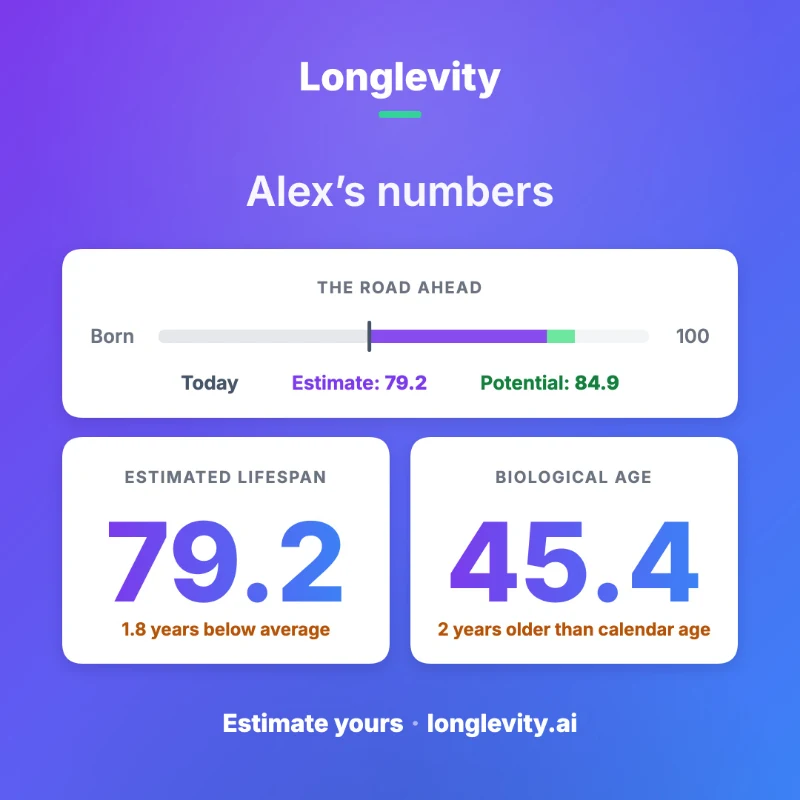
Your road ahead
Estimated lifespanEst. lifespan
79.2
1.8 years below average
Biological age
45.4
2 years older than your calendar age
Summary
Eight of your habits still have years in them. On exercise, you told us: "Not active: I don't exercise". Moving that one habit to its best is worth about 2.1 years of expected life, more than any other single change in your profile, and it is the biggest single reason your biological age reads older than your calendar age.
The good news is unusually good. Because your biggest lever is a behavior, not a diagnosis, the 5.7 years between your estimate and your potential are still on the table, and the largest piece moves with your top priority. This report ranks every lever by the years it could add, shows you the evidence, and ends with a 90-day plan.
Your shape
Ten habits make one shape, and yours has a name.
Your longevity archetype
The Coaster
Emotionally grounded, physically coasting.
Your shape reaches widest at weight and alcohol, and they are quietly carrying you. The notch at exercise and sleep is the shape's deepest point; your years are waiting at exercise and diet.
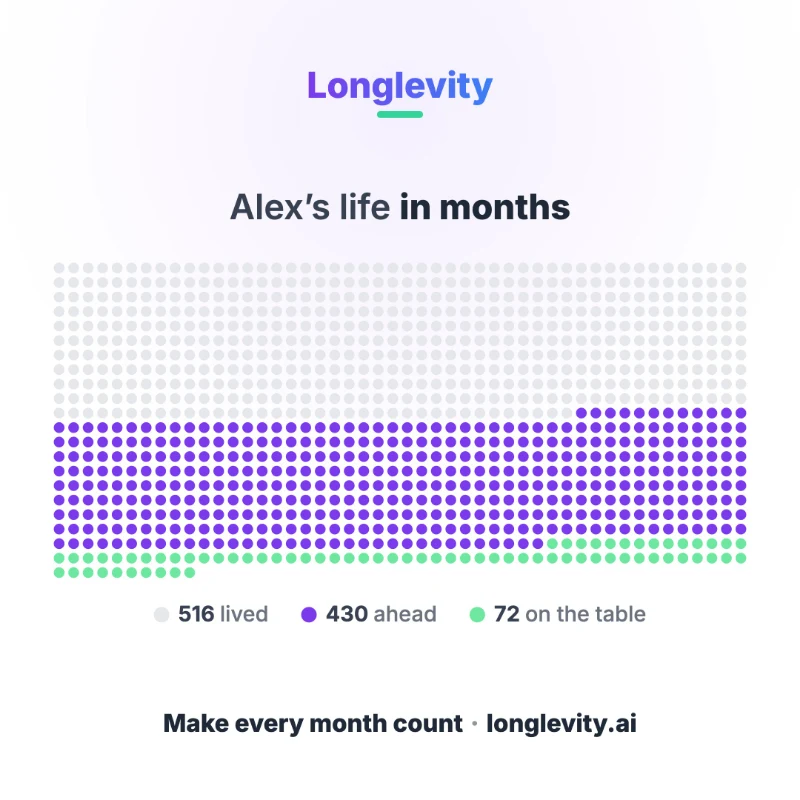
Your life in months
Every dot is one month. Grey is lived, purple is where your current habits are headed, and green is what better habits can still earn.
516 lived434 ahead68 on the table
Where the green months live
Smaller amounts sit with stress, health checks, relationships, alcohol and purpose. Levers overlap, so combined gains converge toward your potential rather than stacking past it.
Your levers
What each habit is doing to your biological age today, from the one ageing you most to the one protecting you most.
Each habit is measured on its own, against an average answer for your age and sex. The priorities below follow a different order, the years each habit could still add to your life, biggest first.
Your ten-year projection
A projection, not a promise. This is your biological age over the next ten years. Better habits slow the climb, and the purple line is your ceiling with every habit at its best.
Your priorities
Your top three, in order. Every action that makes a health claim is evidence-graded and safety-screened.
Before you start
These are educational suggestions, not medical advice. Talk to your doctor before changing your diet, exercise, medications, or health routine, especially if you have a health condition or take medication.
Exercise +2.1 years available
You said: "Not active: I don't exercise".
Why this matters
Adding even small amounts of regular movement is one of the most powerful things you can do for your health. The biggest gains come from going from zero to just a little. If you're over 45, sedentary for years, or have a chronic condition, check with your doctor before starting.
The evidence
In 661,137 adults pooled across six cohorts, about 150 minutes a week of moderate activity was associated with a 31% lower risk of death versus none, with the largest gains at the first step up from inactivity (Arem et al., JAMA Internal Medicine, 2015). Newer device-measured work agrees. About 7,000 steps a day roughly halved all-cause risk versus 2,000 (Ding et al., Lancet Public Health, 2025).
What to try, picked for your answer
Safety note
If you have been inactive for years, are over 45, or have a heart condition, check with your doctor before ramping up, and stop for chest pain, dizziness, or unusual breathlessness.
Diet +1.5 years available
You said: "Below average: a few healthy meals".
Why this matters
You're mixing whole and processed foods. Each meal you move toward whole foods counts, and the dietary modeling shows the earlier and more fully you shift, the more years it is worth.
The evidence
Modeling of large cohort data estimates that a sustained shift toward a whole-food pattern adds years of life, with bigger gains the earlier it starts (Fadnes et al., PLOS Medicine, 2022, re-validated by the authors in 2024). Pooled observational work points the same way. Across about 2 million people, closer Mediterranean-style adherence tracked with roughly 8% lower all-cause mortality (Sofi et al., 2010).
What to try, picked for your answer
Sleep +1.0 years available
You said: "Poorly: rarely get the rest I need".
Why this matters
Sleep is one of the highest-impact changes you can make, and the gains are steepest for the people getting the least. Small, consistent changes count: a fixed wake time and a darker, cooler room move the numbers more than any gadget.
The evidence
Across 79 cohort studies pooled in a 2025 GeroScience meta-analysis, mortality risk follows a J-curve with its low point near 7 to 8 hours. Short sleep carries about 14% higher all-cause risk, long sleep about 34%. This confirms Cappuccio and colleagues’ foundational 2010 meta-analysis of 1.4 million people, and recovery is real. Risk falls toward baseline as duration normalizes.
What to try, picked for your answer
The rest of your levers
One move for each, worth taking or worth keeping.
Your 90-day plan
For the next 90 days, check a box each time you complete one of these habits. Start with the first one or try all three at once.
Explore the full habit library
Your three moves are the start, not the ceiling.
Every action that makes a health claim carries its evidence grade and source.
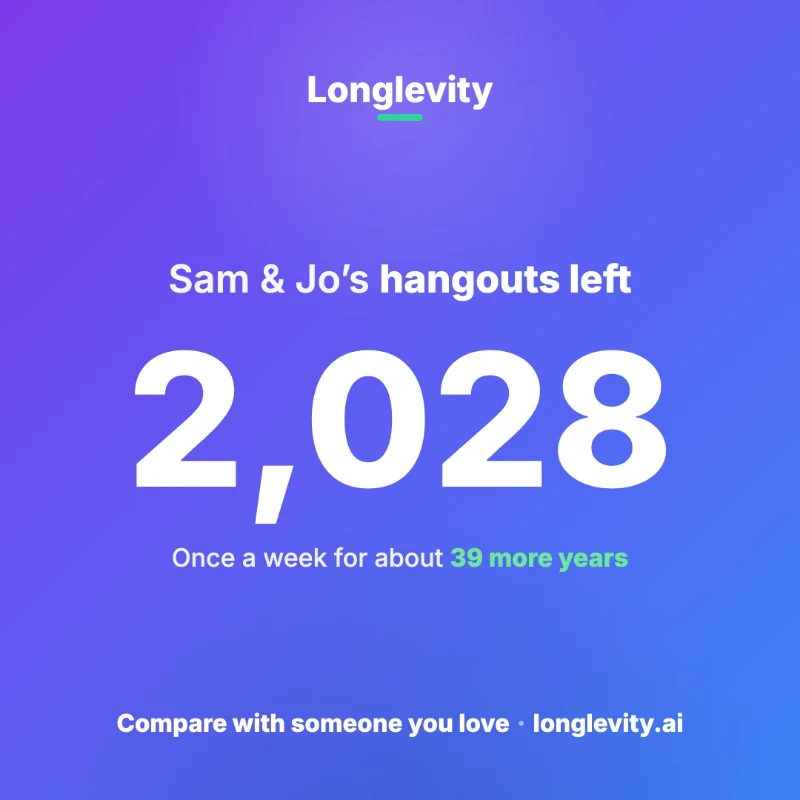
Longevity is better together
Share a card with someone you love.
Every number here is computed from your answers against peer-reviewed research covering 40 million participants; the full method, every study, and every limitation are public at longlevity.ai/methodology. "Vs average" compares you with the average for someone your age and sex, the same average Longlevity shows everywhere; the difference is your habits, your build and your family history. Computed by engine 2.2.3. Estimates inform, they do not diagnose.
Grades on the actions above: Strong evidence = randomized trials, meta-analyses, or large replicated cohorts. Emerging evidence = promising but earlier. No grade = a settled basic or a how-to method that makes no health claim.
Curious what yours would say?
Free for everyone. Your own report is one tap after your results.
Start with the free assessment →